How to Fortify Your Hexes
The way to stop needing a way back: walls. This chapter is the whole life of a ZapWall — up with Fortify, down with Decay, never below the floor.
Fortify
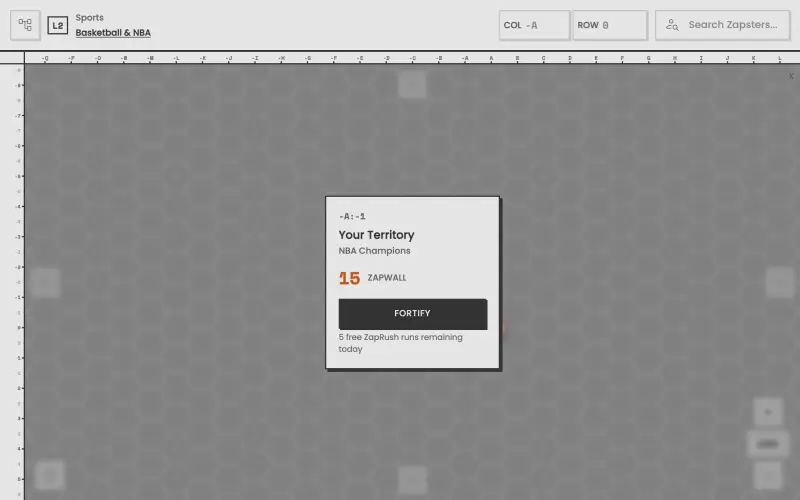
Fortify is the only way a wall goes up: a ZapRush played against your own hex. The wall doesn't rise by one — it rises to your streak, so one sharp run can turn a 14 into a 25.
There is no losing move here. A failed Fortify changes nothing, and even then the run's Volts bank to you and feed the hex. The only cost is the daily run it came from. Below: a real Fortify — the win, the decay it causes, and the miss.
- 1Open one of your own hexes on a ZapMap and choose Fortify.
- 2You play a ZapRush — it comes out of your free daily runs, like every ZapRush.
- 3Your streak beats your current wall — the wall rises to exactly your streak.
- 4Fall short — the wall stays where it was. Nothing is risked.
- 5Either way the run pays twice: its Volts bank to you, and they're added to the hex's worth.
Decay
Walls don't only rise. Every successful Fortify presses on the hexes it touches — which means on a busy border, a wall you never re-raise sinks point by point toward 10.
Fortify is maintenance, not a one-time move. The players who hold their positions are the ones who keep running.
- 1The moment a Fortify succeeds, every touching enemy wall drops by 1.
- 2Yours drop the same way when a neighbor's Fortify lands.
- 3The bell names the exact hex and the new number, every time.
- 4Decay never drags a wall below 10 — the floor holds.
- 5Quiet borders keep their walls forever. Decay is never time-based.
Lost ground comes back, walls go up, pressure grinds them down. Next: ZapFolio — everything you hold, in one place.