How ZapInto Works
ZapInto is trivia with consequences. You answer questions — and what you win stays on the board: land with your name on it, scores other players have to respect, records they'll try to break.
This page is the whole game, told in order — from a single question to the map every veteran ends up sharing. Thirteen short parts, each one small, each one exact.
It starts with a question
One question on screen. Four answers. A few seconds on the clock. In ZapInto a question is called a Zap — and this is the whole game in miniature: read fast, trust what you know, lock it in.
Every Zap hides a pool of nine wrong answers behind the three it shows you — so the same question never looks quite the same twice.
Which team drafted Dirk Nowitzki in 1998?
Questions come in games of two types
Zaps are packed into games, and games come in exactly two types.
ZapStacks are sets: one subject, 15 to 50 questions, played start to finish in one sitting, no checkpoints. Jordan's retirement. The Dune universe. Greek monsters.
ZapRush is infinite trivia: no set and no last question — Zaps keep coming until your first miss, and your streak of right answers is the score.
Same questions, same rules, same pay. They differ only in where they end.
Every ZapStack lives in an Arena
Here's where ZapInto leaves every other trivia app behind. Every ZapCore has an Arena — a board of hexes, one hex per ZapStack. Finish a ZapStack and its hex becomes yours: a piece of land called a ZapLand, with your name on it, visible to every player who passes by.
Open topic, open game, open hex: play it, finish it, own it. Your first claim takes about five minutes.
Your score stays on the land
The hex you claimed shows a number: your Charge — the percentage of Zaps you answered right. It isn't decoration. It's the hex's defense.
Not proud of an 80%? Replay your own ZapStack whenever you like — your best run becomes the new Charge. And the score on the land is more than defense. It's points.
Volts: the points
Volts are the game's points, and every right answer pays them: 1 Volt on an easy Zap, 2 on a medium, 3 on a hard — identical in both game types. There is no separate scoring anywhere; a ZapStack pays the same Volts a ZapRush does.
The only difference is where they land. ZapRush Volts are banked to you the moment a run ends — yours forever, nothing in the game can remove them. ZapStack Volts go onto the hex the run claims: they are the hex's worth, your Charge defends them, and losing the hex means losing them.
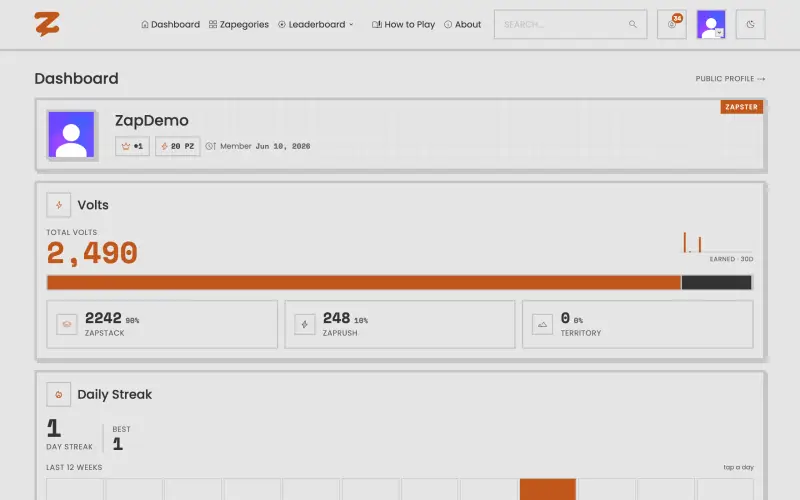
What your runs have banked plus what your claimed hexes hold — that's your total, the number the leaderboards rank you by.
Duels: hexes change hands
On these maps, land is never safe — only well-defended. Rivals whose land touches yours can Duel your hexes: their run against the score that guards it.
It cuts both ways. Every hex touching your land — including ones you lost — can be yours the same way. See a weak Charge on your border? That's not a hex. That's an invitation.
- 1The challenger replays your ZapStack — same questions, same rules.
- 2More correct answers than your Charge — they take the hex, Volts and all.
- 3A tie goes to the faster total time.
- 4You don't need to be online. Your Charge defends for you.
So far, one Arena. But the maps stack — and finishing things is how you climb.
Finish the path, unlock the map above
ZapStacks belong to learning paths called ZapCores — a topic's games arranged from beginner to advanced, each with its own Arena.
Finish every ZapStack in a ZapCore — finished, not perfect — and you've outgrown it. The bell rings: the territory map above is unlocked, and a free hex on it is already yours. You don't play for it. You already did.
Infinite trivia: ZapRush
Before the climb continues, the second game type in action. A ZapRush run is scored by its streak — and every topic keeps a public record: the best streak ever run there, with the holder's name on it. Beat it, or match it faster, and the record is yours.
You get 5 free runs a day — 15 with Zap+ — each banking its Volts for good; up on the bigger maps, ZapRush is also how battles are fought.
ZapMaps: land you can never lose
The map above the Arenas is a ZapMap — the territory maps, one per topic. Place your earned hex along the frontier, and breathe out: territory is never taken away. Not by anyone, not ever.
Land rewards company here exactly as it does below: each neighboring hex you own adds 10% to a hex's worth, up to double in a full ring. And everything you hold or haven't placed yet sits in your ZapFolio, your inventory across every map.
Castles: positions trade, nothing burns
Rivals still have one move against you: Castle. Win or lose, no land leaves the map and nobody goes home empty — positions trade, walls reset, and the war moves one hex over.
- 1A rival plays a ZapRush against your hex's wall.
- 2Beat the wall with their streak — you two swap positions. Their old hex is yours now.
- 3Fall short — nothing moves, nothing is lost.
- 4Castles go both ways. Wanted a better spot? Go take one.
Walls: Fortify up, Decay down
A 14 wall is a stroll. A 25 wall is a real ask. A 40 wall is a statement. Where you set yours is where you set your risk — and your neighbors' mood.
Because walls don't only rise. Every time a rival lands a Fortify next door, your wall decays by one — and the bell tells you exactly which wall, exactly where. Busy borders grind each other down. That's not a flaw; that's the pressure that keeps every neighborhood honest.
- 1Every territory hex is guarded by a ZapWall — it starts at 14.
- 2Fortify: a ZapRush against your own wall. Beat it, and the wall rises to your streak.
- 3Decay: every successful Fortify drops each touching enemy wall by 1. Theirs when you build — yours when they do.
- 4Decay is never time-based. Walls only move when someone plays.
- 5The floor is 10. Once a wall is there, no amount of neighbor traffic drags it lower.
The climb to the top
What you did to one ZapCore, you can do to a whole topic: finish everything in it, and its parent's map unlocks. Topic maps feed the General map — the single board at the very top, shared by everyone who made it this far.
The game begins in your favorite corner of trivia. It ends with everybody on the same map.
That's the whole game on the ground. One question left: who's winning it?
Seven leaderboards, seven ways to be good
All public, all live, all built for bragging. Pick the one that sounds like you, and start climbing it.
That's the game.
A question, two game types, an Arena — then duels, ZapMaps, walls, and a climb that ends with everyone on the same board. Your first hex is one finished game away.
Sixty seconds inside
Real screens, real data. Click through it.
Go deeper
The Basics
Zaps, ZapStacks, ZapCores, ZapRush — the games and the score worth fighting over.
The Arena
Where land changes hands: reading the board, claiming, Charge, replays, and every instrument.
Duels
Their hex, their game, their posted score — your run against all three.
Reclaim
Losing a Duel is never the end. The way back is the same Duel, pointed at your old ground.
ZapMaps
The territory maps above the Arenas: land you earn, place forever, and wall in.
Castles
Your ZapRush streak against their ZapWall. Positions trade, nothing burns.
Fortify
The whole life of a wall: up with Fortify, down with Decay, floor at 10.
ZapFolio
Your inventory: every position you hold, every claim waiting to be placed.
Progression
Badges, ladders, leaderboards, streaks, ZapTrail — everything that's counting.
Notifications
The bell knows first: duels lost, records taken, ground earned — and what to do about each.
Your Account
Your HQ, your profile, search, and settings.
Powering Up
PowerZaps, Zap+, and what money never buys.
Glossary
Every word we made up, defined — the full ZapInto vocabulary.