How to Play: The Basics
Underneath the maps, the duels and the walls, ZapInto is a trivia game. This chapter is that bottom layer: the question itself, the games it comes in, the paths the games line up into — and what a right answer is worth.
Eight short parts, one term each, in the order you'll meet them on screen.
Zap: one question on a clock
A Zap is a single trivia question. Four answers are on screen: the right one, and three wrong ones drawn from a pool of nine that every Zap carries — so the next time you meet the same question, the line-up looks different.
The clock is fitted to the question: longer questions get more time, harder ones get a few extra seconds, a picture adds a moment to look — and no Zap gives you less than seven seconds.
After you answer, the right answer is shown together with a short explanation — every Zap in the game carries one. Get it wrong and you still walk away with the fact.
Which planet has the shortest day?
Jupiter spins once in under 10 hours — the fastest rotation in the solar system.
ZapStack: a set you finish in one go
Zaps come packed in ZapStacks: one narrow subject, 15 to 50 questions, shuffled fresh on every run and played start to finish in one sitting. There is no save point — a run you don't finish doesn't count.
The result is two numbers: how many you got right, and how long the whole run took. Right answers decide everything; time only matters when two results are equal.
Clear a stack of 20 or more without a single miss and that's a perfect run — counted once per ZapStack, kept on your profile for good.
ZapCore: a subject from easy to hard
ZapStacks on the same subject line up into a ZapCore — 5 to 14 games, sorted easy first, hard last. The opening stack is for anyone; the closing one is for people who actually know the subject.
Each ZapCore has its own map, where every finished game can claim land — that's the next chapter. What matters here: finish every ZapStack in a ZapCore — finished is enough, perfect is not required — and you earn a free hex on the bigger map above, plus the map itself the first time.
Zapegory: topics, two levels deep
Topics are organized on two levels, called Zapegories: roots — Sports, History, Science — and subtopics under them, like NBA under Sports or World War II under History.
All the playing happens in the subtopics: that's where the ZapCores and their ZapStacks live. The roots only keep things in order — there is no "Sports" game to play. The tour below shows it on the real screens.
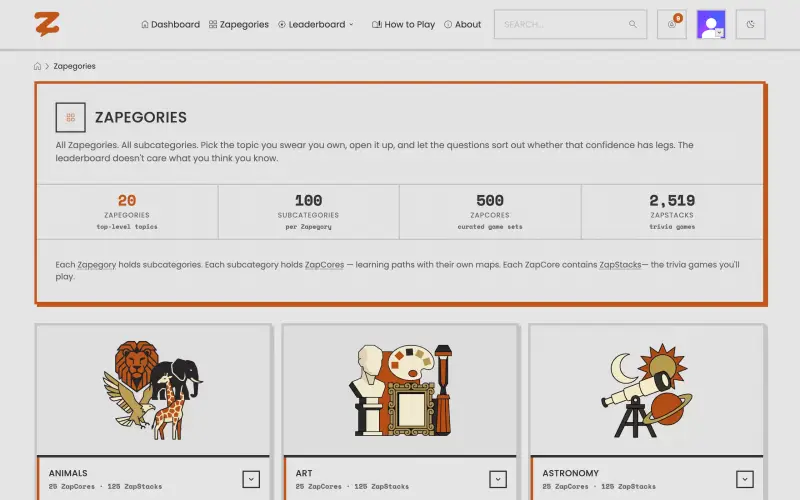
The game keeps growing: new ZapStacks are added all the time, subtopic by subtopic.
ZapRush: trivia with no end
The second way to play. ZapRush has no question count and no last question: Zaps keep coming, one at a time, until you pick wrong or the clock runs out. Either one ends the run on the spot, and how many you answered in a row is the run's score. Below: a real run, first Zap to STREAK ENDED.
The stream tilts against you as you go: a fresh run serves mostly easy Zaps; past 20 in a row, most of what arrives is hard. Long runs are not luck.
You get 5 free runs a day — 15 with Zap+. Fortify and Castle battles on Territory maps — each has its own chapter — are ZapRush runs too and draw from the same daily budget; extra runs cost PowerZaps.
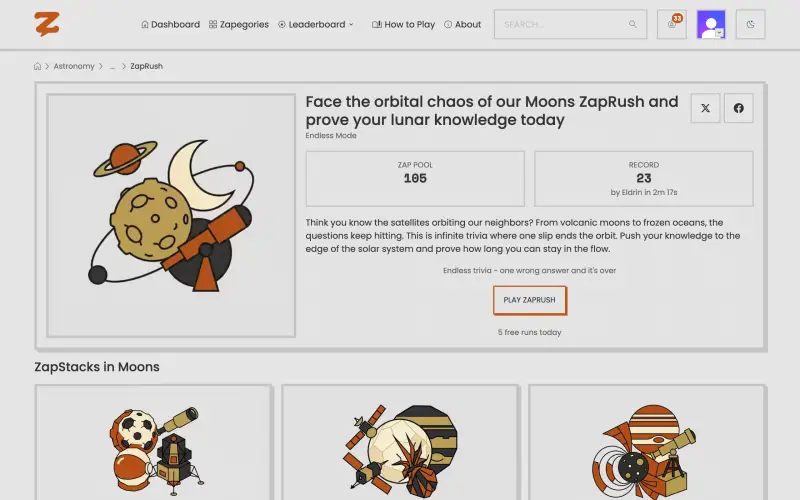
Streaks and records
Your streak is the count of right answers in a row inside one run — the number a ZapRush is scored by, and the number everything else gets measured against.
Every place you can run a ZapRush — each topic, each ZapCore — keeps a public record: the best streak ever run there, with the holder's name on it. Any record can be taken: run a longer streak, or the same streak faster, and the name changes to yours. The old holder hears about it from the bell.
Only standalone runs set records — paid extras included. Fortify and Castle runs measure their streaks against walls instead; that story is in the Territory chapter.
Volts: what right answers pay
Volts are the game's points, priced per question: a correct answer pays 1 Volt on an easy Zap, 2 on a medium, 3 on a hard. Every game type pays the same way.
Where the Volts go depends on the game. A ZapRush run banks them to you the moment it ends — every run you have ever finished stays in your total, and nothing in the game can remove it. A ZapStack run puts them on the hex it claims: they count toward your total while the hex is yours, and they leave with it if a Duel takes it.
What your runs have banked plus what your claimed hexes hold — that sum is your total, and it's the number the rankings read.
The dashboard: the whole game on one screen
Everything this chapter named reports to one screen: your total Volts, your streaks, perfect runs, badges, every hex you hold and every claim still waiting. That screen is your dashboard — signing in lands you on it, and it updates the moment any run ends.
The tour below is the real screen, ten stops.
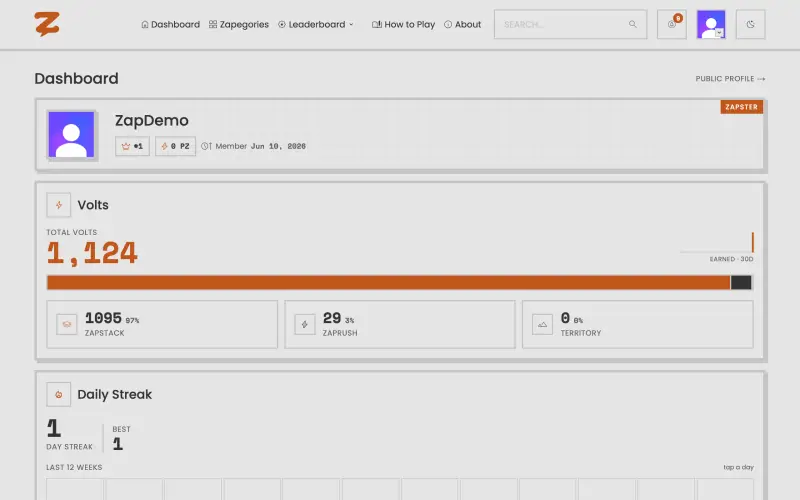
That's the trivia layer: Zaps packed in ZapStacks, ZapStacks lined up in ZapCores, runs paying Volts. Next: what finishing a game actually wins — land.